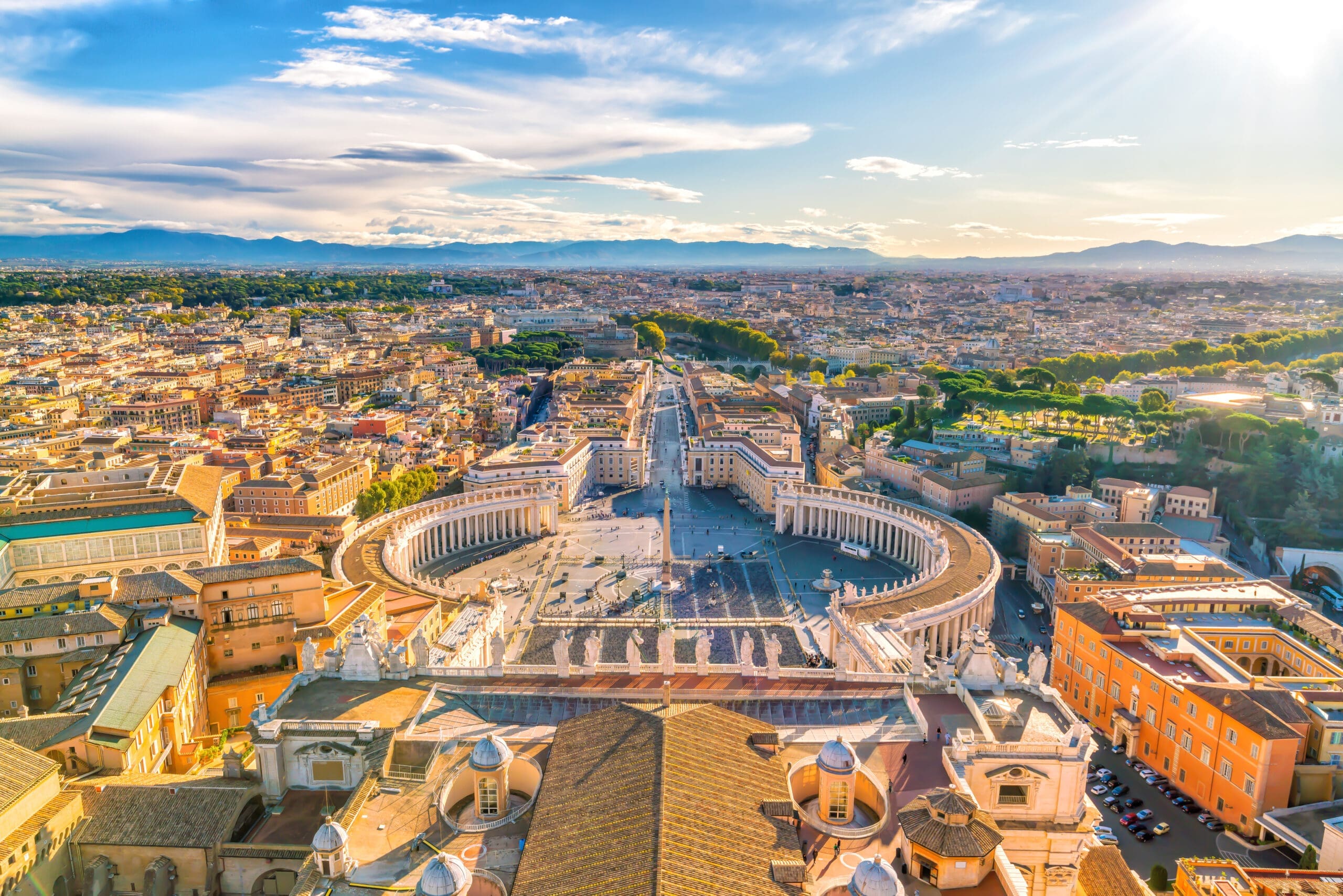
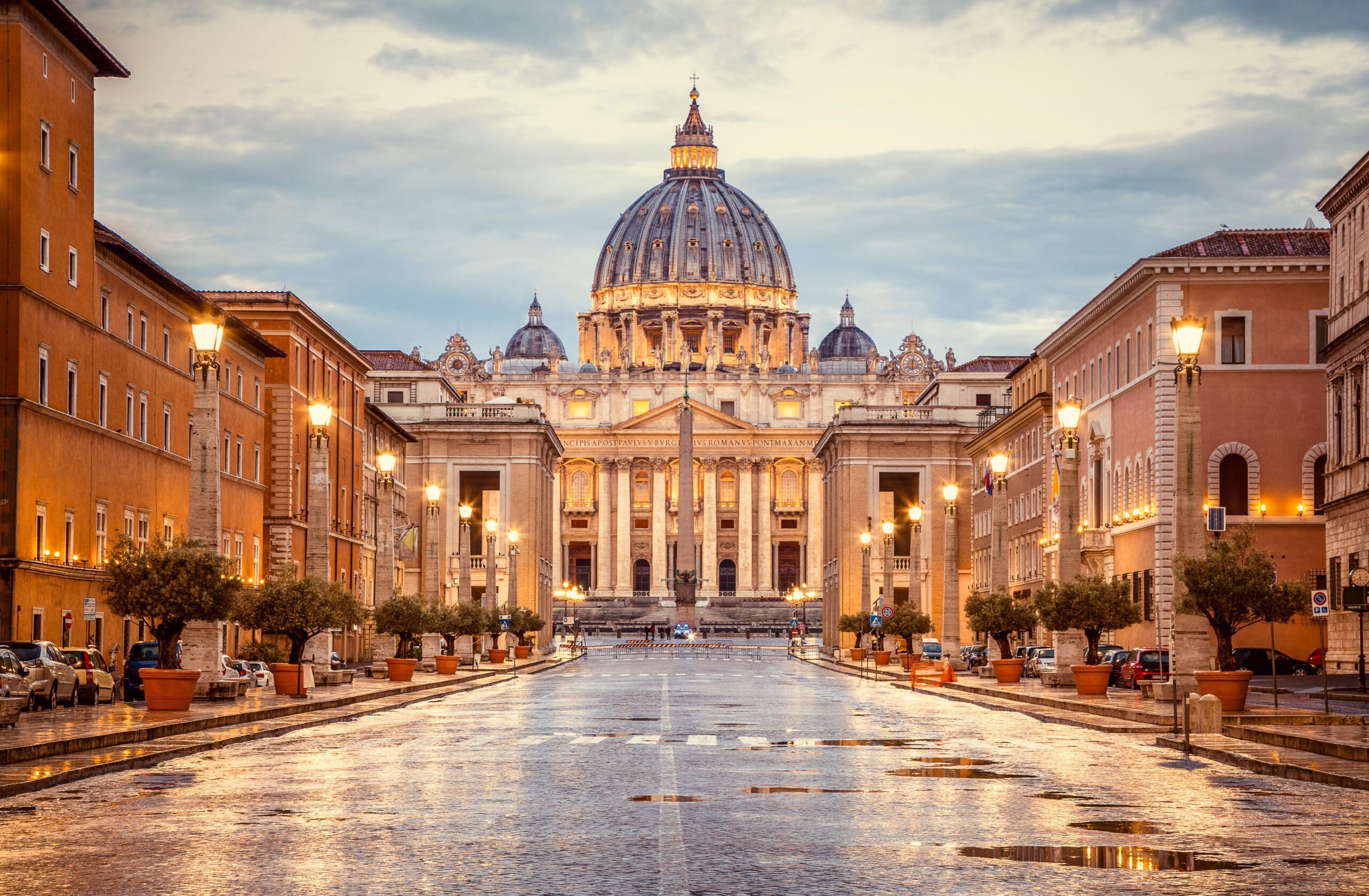
Catholic Group Pilgrimages to Rome, Assisi and the Shrines of Italy
Three routes, fifteen departures through 2028, daily Mass throughout — or travel on your parish’s own dates.
Fifteen Italy departures, plus six pilgrimages with an Italian leg. Each group has its own host, dates and itinerary — the three routes below are the ones we run most.
Our standard Italy route, by coach throughout. Four nights based in Assisi with day trips out to Siena and Orvieto, then four nights in Rome.
Rome · Assisi · Siena · Assisi · Orvieto · Rome
Siena and Orvieto are both reached from Assisi and returned to it — no packing between them.
Italy is the one destination where the whole arc of the Church is walkable. In Rome you stand where the apostles were martyred and where the Church learned to govern itself. Ninety miles north, in Assisi, you stand where it learned, in the thirteenth century, to give everything away. Most pilgrimages to Italy are really a movement between those two poles, and the good ones are built so that the pilgrim feels the contrast rather than simply visiting both.
That is why the order matters. A group that starts in Rome — the scale, the marble, the crowds, the Vatican — and then goes up to Assisi tends to experience Assisi as relief and as correction. A group that starts in Assisi and comes down to Rome experiences Rome as fulfillment: the small poor thing that grew. Neither is wrong, but it should be a decision.
Beneath that arc, Italy carries three devotions that shape our routes. The Franciscan story, which is Assisi and its satellites — La Verna, where St. Francis received the stigmata; Greccio, where he made the first crib. The Eucharistic story, which runs south and east through Orvieto and Lanciano, where the Church keeps relics of miracles it has examined and permits to be venerated. And the story of holiness in living memory — Padre Pio at San Giovanni Rotondo, who was hearing confessions until 1968, and St. Carlo Acutis at Assisi, who died in 2006 and was canonized in 2025.
Those three threads are why we run three distinct Italy routes rather than one. They go to genuinely different places, at a different pace, for different groups.
Clergy review required on this section and on every reference to indulgences, Eucharistic miracles and the canonical standing of shrines elsewhere on this page.
Each built from itineraries we actually operate, not assembled from a map. Counts are live departures.
The classic route and the one most first-time groups should take. Four nights in Assisi with day trips out to Siena and Orvieto, then four in Rome for the papal basilicas, the Vatican and the catacombs. This is the route behind more of our departures than any other, and the one we would put a parish group on if they asked us to choose.
Assisi, then east to the Adriatic and south into Puglia: the Holy House at Loreto, the Eucharistic miracle at Lanciano, San Giovanni Rotondo where Padre Pio lived and is buried, the cave of St. Michael at Monte Sant’Angelo, and the abbey of Monte Cassino on the road back to Rome. A harder drive than the classic route, for groups with a Eucharistic or Marian devotion.
The narrowest and slowest of the three. Assisi in depth — seven sites over four days rather than one rushed afternoon — then La Verna, where St. Francis received the stigmata, Greccio, where he built the first Christmas crib, and Gubbio. Suits religious communities, Secular Franciscans, and groups who would rather see four places properly than nine badly. The date to plan around is 16 July 2028, the eight hundredth anniversary of his canonization.
Fourteen of them in ten days — and Mass in the shrine itself, not in a hotel function room.
Her incorrupt body lies in the crypt, and above it hangs the San Damiano crucifix — the actual painted cross from which St. Francis heard the words “rebuild my church.” It was carried up from San Damiano by the Poor Clares in 1257 and has been here ever since.
Two churches stacked on one another, begun in 1228 within two years of his death. The upper basilica carries the Giotto fresco cycle of his life; the lower leads down to the stone tomb where his body was hidden for six centuries and rediscovered in 1818.
A vast baroque basilica built to shelter one tiny stone chapel. The Porziuncola is where St. Francis received his vocation, clothed St. Clare, and died on the bare ground in 1226. Mass here on day three.
The hermitage in the woods above Assisi where Francis and the first friars withdrew to pray. There is almost nothing built here — a cave, a few cells cut into rock, an ilex wood. It is the quietest place on the route and the one pilgrims ask to stay longer at.
The half-ruined chapel Francis rebuilt with his own hands after the crucifix spoke to him, and later the first monastery of St. Clare and her sisters. She lived here forty-one years and died here. Her dormitory and the little garden are still as they were.
Santa Maria Maggiore, named for the day Francis stripped off his clothes in the square and handed them back to his father. It now holds the tomb of St. Carlo Acutis, the first millennial saint. Mass here on day four.
Home to the relics of St. Catherine of Siena — one of only four women named a Doctor of the Church, co-patroness of Europe, and the laywoman who wrote to popes and got answers.
Black-and-white banded marble inside and out, a Pisano pulpit, and a floor of inlaid marble panels uncovered only weeks each year. Then out into the shell-shaped piazza where the Palio is run.
The cathedral was built to house one object: the blood-stained corporal from the Mass at Bolsena in 1263. That event stands behind the institution of the feast of Corpus Christi. Mass here on the road from Assisi to Rome.
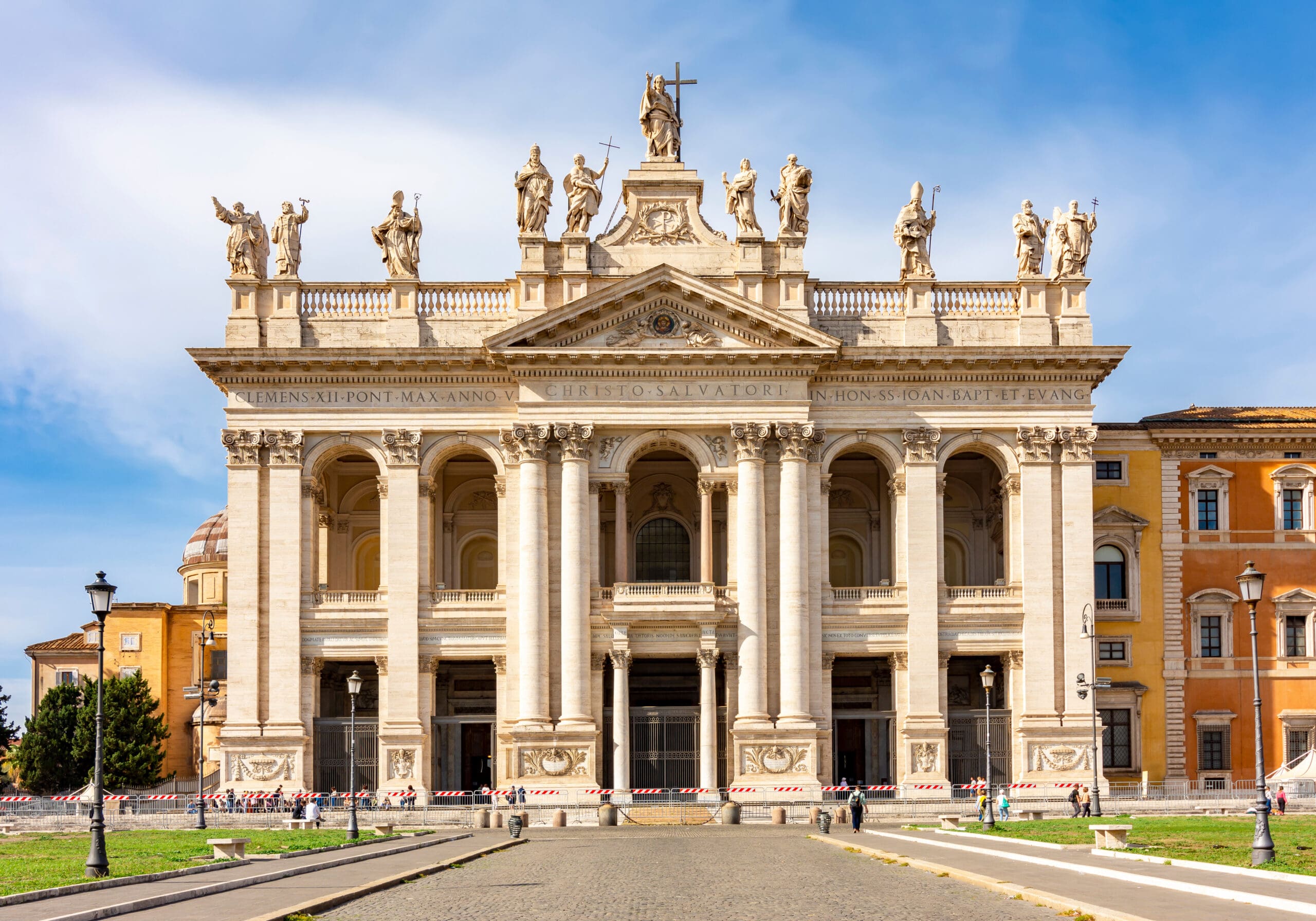
Not St. Peter’s but this is the cathedral of Rome and the mother church of the world. Across the road, the Scala Santa — twenty-eight marble steps venerated as those Christ climbed to Pilate, still ascended on the knees.
One of the oldest churches in the world dedicated to Our Lady, standing essentially unchanged since the fifth century, with mosaics from that period still in place. Pope Francis is buried here — the first pope laid to rest in this basilica since 1669.
Built over the burial place of the Apostle Paul. Above the nave runs a portrait medallion of every pope in history, from Peter to Leo XIV. Mass at the tomb.
Twelve miles of galleries on four levels where half a million early Christians were buried, including nine third-century popes. You walk a stretch of the original Appian Way to get there. Mass underground.
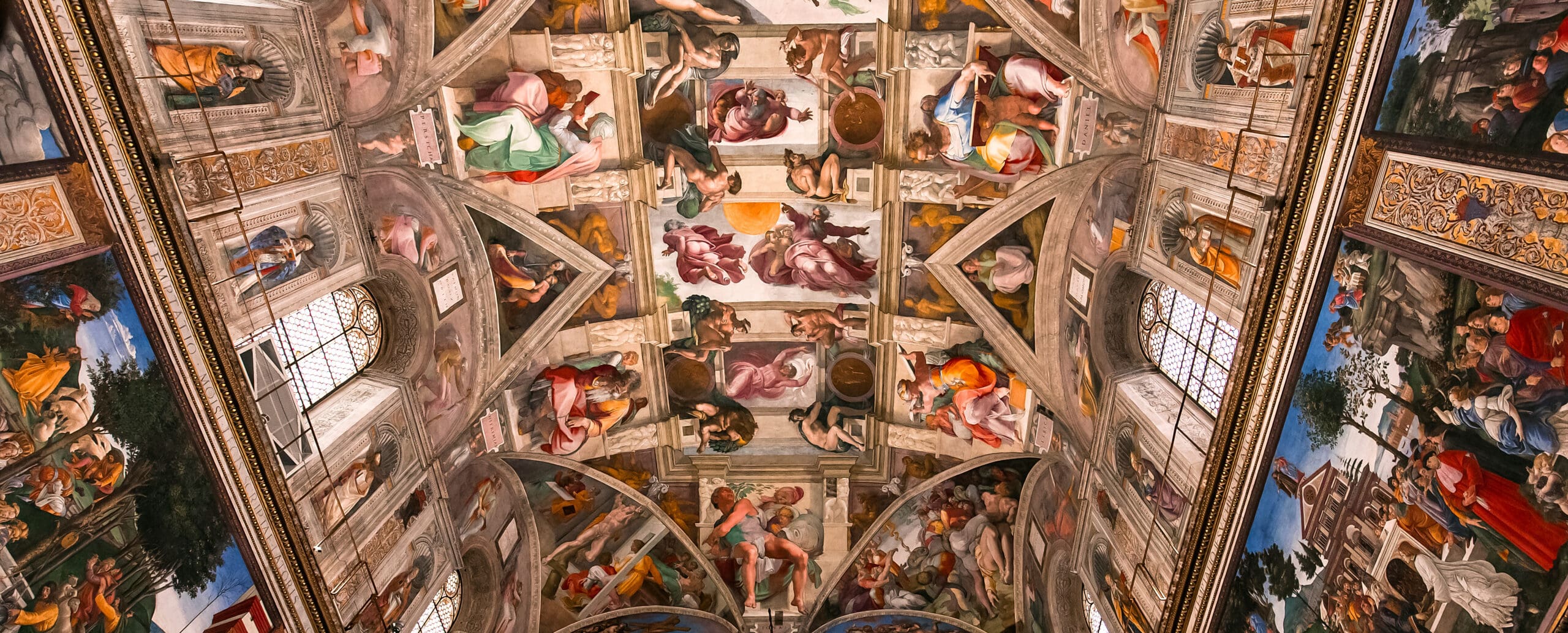
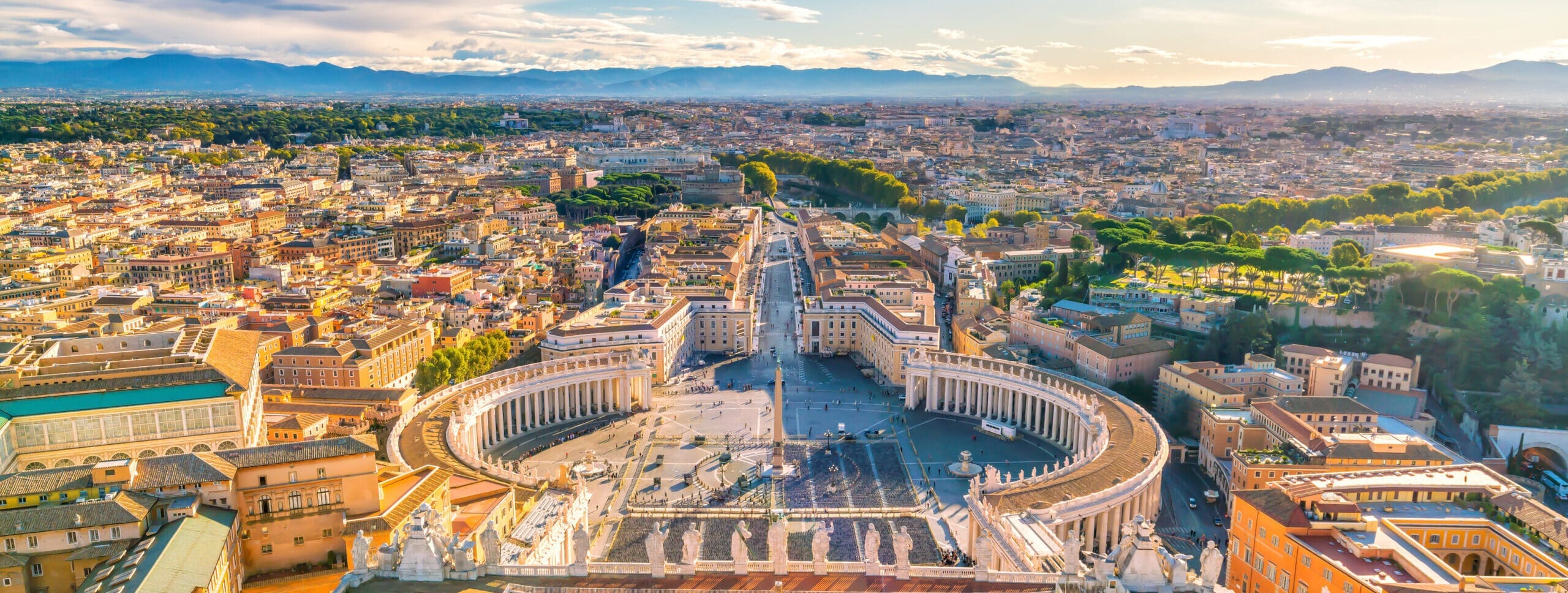
The Wednesday audience in the square with pilgrims from every continent, then the Vatican Museums and Michelangelo’s ceiling, finishing at the tombs of St. Peter and St. John Paul II beneath the high altar.
This is the route we most often run for groups in Italy — four nights in Assisi with day trips to Siena and Orvieto, then four in Rome. Your group travels on its own dates, and the itinerary can be adjusted to fit the time you have and the places that matter most to your pilgrims.
“Testimonial to follow.”
Every review below was written by a pilgrim on Google, unprompted, after coming home. We answer all of them, including the difficult ones.
Incredible experience from boarding the plane to the very end of this pilgrimage. Each detail so thoughtfully planned out. Felt safe, cared for and no missed steps.
Sara Correia Google review
My wife and I just returned home from a wonderful Canterbury pilgrimage to Italy led by Father Joao Silveria and Dr. Taylor Marshall. What a great experience.
Chris Western Google review
Canterbury and the tour managers led us around Rome, seeing and learning about history we would never have been able to access on our own.
Jesseca Fratantoro Google review
Travelling with a group for the first time raises fair questions. The pace, the hotels, how Mass is arranged, whether anyone will look after you if something goes wrong. Call us and ask. +1 (800) 653-0017, Mon–Fri | 9am – 5pm ET.
Two-thirds of our Italy departures exist because a priest or a parish organiser came to us with a group and a window. Tell us the window you have in mind and we will build the itinerary around it.
These inclusions can be easily tailored to the individual needs of your group
Every pilgrim in your group gets the app. Their itinerary, hotels and flights, the prayers of the day and a way to reach one another — in one place, and kept current as the pilgrimage unfolds.
Your whole group in one thread, so a change of plan reaches everyone at once.
The full day-by-day schedule, always current, in every pilgrim’s pocket.
Where the group is staying each night, with addresses and dates.
Flight details kept alongside everything else, not in a separate email.
The prayers of the day, including the Liturgy of the Hours.
A keepsake record of the shrines your group visits along the way.
Times and meeting points pushed to everyone the moment they change.
Published prices, deposits, group sizes and lead times — the numbers every group leader asks for first.
Our fifteen published Italy departures for 2026 to 2028 run from $4,395 to $6,850 per pilgrim, and the six ten-day departures currently on sale run $4,395 to $5,399. Length is the biggest driver, then your departure city and the time of year. A private group travelling on its own dates is priced individually — tell us your target per-person figure and we will build the itinerary to it rather than the other way round.
Four-star hotels, private motorcoach throughout, breakfast and dinner daily with wine at some dinners, a dedicated tour manager with your group from arrival to departure, licensed local Catholic guides and all admission fees, porterage at hotels, whisper headsets while touring, tips for hotel and restaurant staff, daily Mass booked in advance, the Canterbury mobile app, reservation support 9–5 ET and 24/7 emergency support while you are abroad.
Every published departure is priced from a named US gateway — the departure city is on each card — and we hold the group air contracts rather than leaving your pilgrims to book their own flights. Ask a consultant what the quoted price covers for the specific departure you are looking at, and we will put it in writing before you announce anything to your group.
Most of our groups run between 20 and 50 pilgrims. We arrange smaller tours as well, and at the other end we have organised pilgrimages for groups as large as 2,500 — so whatever size your group turns out to be, we can build for it.
Each pilgrim pays a $450 deposit when they register, of which $200 is non-refundable, and the balance 90 days before departure. Major events such as a beatification or World Youth Day sometimes run on a different schedule. No money moves through the parish — every pilgrim books and pays us directly, so you never hold a deposit or chase a balance.
Yes. Your place is earned by the group you bring and it comes from our suppliers rather than out of what your pilgrims pay. There is no deposit or financial guarantee from you, and if the group does not reach its minimum, final payments are never collected and deposits are returned. A fundraising amount can also be built into the price and returned to your parish.
Most groups start eight to thirteen months out, and waiting is the most common mistake we see. Registration normally closes 90 days before departure; if space remains, later registration is sometimes still possible, so it is worth asking rather than assuming.
April to early June and September to October give you the most comfortable weather and the longest days in the shrines. July and August are hot, and many Italian businesses close in August. Winter is quiet and cheaper, and Rome in Advent and Lent has a character the summer never has. Two dates worth planning around: the Papal Audience is held on Wednesday mornings when the Holy Father is in Rome, and the feast of St. Francis is 4 October in Assisi.
Twelve to eighteen months for a parish group of thirty or more, and longer if you want a specific week — Holy Week, the feast of St. Francis on 4 October, or the days around a canonization fill first. Our current departures run into 2028. Smaller groups can sometimes be placed inside a year, but hotel space in Assisi is the constraint, not the flights.
Yes, and in churches booked in advance rather than wherever there is space on the day. In Rome that normally means one of the four papal basilicas and, for many groups, a Mass in the Vatican grottoes. In Assisi it means the Basilica of St. Francis, where we celebrate Mass beside the tomb of the saint, and the Porziuncola. Both are reserved months out, and the Basilica of St. Francis needs the longest lead time of any church on the route.
The general audience is normally on Wednesday mornings when the Pope is in Rome, and it appears on eleven of our fifteen current Italy itineraries. Tickets are free and requested through the Prefecture of the Papal Household; we handle the request. It cannot be guaranteed — audiences are cancelled for papal travel, for the summer, and for liturgical reasons — so we never build an itinerary that only works if it happens.
More than most people expect. A typical day starts with a 7am wake-up and a 9am departure and returns between 5 and 6pm. Pilgrims should be able to walk three to four miles a day, on uneven surfaces, cobblestones, stairs and significant slopes, with some touring where there is no shade and nowhere to sit. Assisi is built on the side of a hill; Rome is flat but long. If someone in your group cannot manage that, tell us at the planning stage and we will adapt the route rather than leaving them at the hotel.
It is the church in Assisi where St. Carlo Acutis is buried. He was canonized on 7 September 2025, the first saint born in the 1990s. The shrine appears on thirteen of our fifteen current Italy itineraries, which makes it effectively standard. For groups travelling with teenagers or young adults it is often the stop they talk about afterwards.
The Portiuncula indulgence is attached to the Porziuncola in Assisi, under the usual conditions — sacramental confession, Holy Communion, and prayer for the intentions of the Holy Father. It is also obtainable at any Franciscan conventual church or church dedicated to St. Francis. Separately, the Jubilee Year for the eighth centenary of the death of St. Francis attaches a plenary indulgence to a pilgrimage visit to any Franciscan church worldwide until 10 January 2027, so every departure travelling before that date qualifies. Your chaplain will explain the conditions on the day.
A US passport valid for at least six months beyond your return date, with blank pages for stamps. Italy is in the Schengen area, so US citizens need no visa for stays under 90 days. Europe’s ETIAS travel authorisation is expected to begin in late 2026 — we confirm current requirements with every group before departure. Priests concelebrating should carry a celebret or letter of good standing from their bishop or superior.
That is how most of our Italy pilgrimages work. Roughly two-thirds of our current departures were built for a single parish, diocese, school or apostolate on dates that suited its calendar. You bring the group; we build the itinerary, handle registration and payment, and send a tour manager with you.
A pilgrimage consultant replies within one business day. No deposit or commitment.